Energy Market

Energy Market

Energy Market

Filter

Demand-Charge Analysis

$690.00

Find out exactly which half-hours set your demand charge and what a battery, load shifting or power factor correction could realistically save your business.

From $690 (Per site), including GST. Indicative starting price: the final fixed price is confirmed in writing after a site assessment.

SKU: BES-CON-11
Brand: Blue Energy Solar
Pack size: Per site
Form: Digital report
Categories: Commercial
Share it:

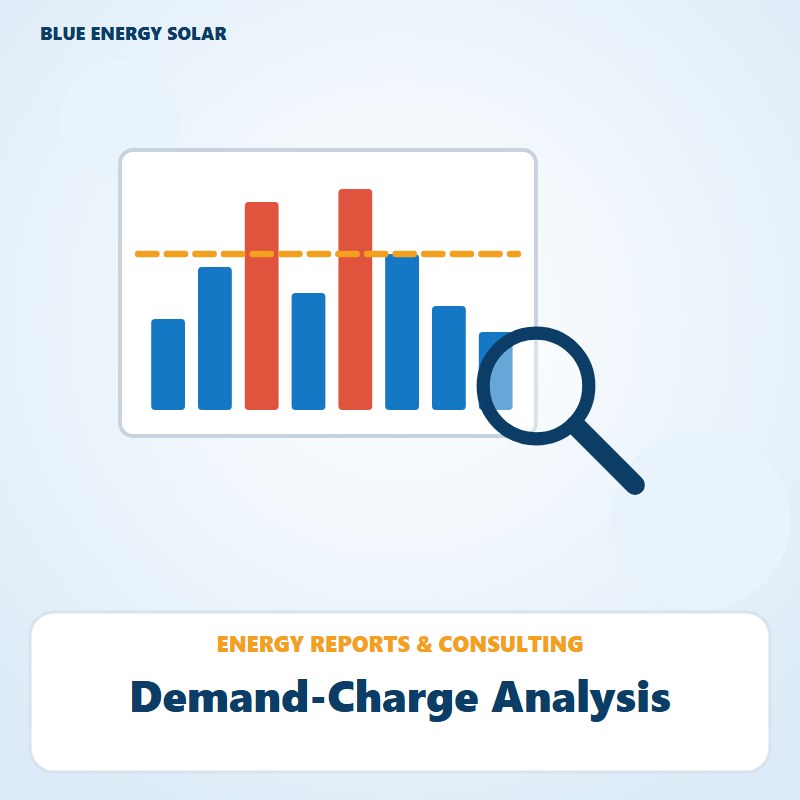
On many commercial tariffs, a single busy half-hour can set the demand charge for a whole month, and on some tariffs for longer. Because the charge is based on the highest rate of draw rather than total energy, businesses often pay heavily for a few short peaks they do not know about. Our Demand-Charge Analysis finds those peaks, explains what caused them and tests which options would reduce them.

The analysis is priced from $690 per site as an indicative starting price, confirmed in writing once we have seen your tariff and data.

What's included

  • Review of your network tariff and how the demand charge is calculated, in kW or kVA, monthly or rolling
  • Identification of the half-hours that set the demand charge in each billing period
  • Likely causes of each peak, such as equipment start-ups, cooling or coinciding processes
  • Battery peak-shaving model: the size needed and the estimated demand reduction
  • Load-shifting options, such as staggering start-ups or moving flexible loads
  • Power factor review and whether power factor correction (PFC) could reduce a kVA demand charge
  • A digital report comparing options by indicative cost, saving and payback

Why Blue Energy Solar

Demand charges can be a significant share of a commercial bill, yet many businesses cannot say when their peak occurred last quarter. We design commercial solar and batteries to target that peak, not just total usage, so we understand which options tend to work in practice and which only look good on paper. Some peaks are best solved with no hardware at all, and when that is the case, the report says so plainly.

Recommended for

Commercial sites on a demand tariff whose demand charges are a large or unpredictable part of the electricity bill.

Solar alone often does little for demand charges when peaks occur early in the morning, late in the afternoon or on cloudy days. A battery can reduce peaks, but only if it is large enough and controlled to discharge at the right time. Power factor correction only helps where the demand charge is measured in kVA and the power factor is poor.

From 1 September 2026, eligible NSW business batteries from 20 kWh may attract state incentives. We note where this could apply, and you should confirm current values on the official NSW page before signing. Savings estimates depend on how the site operates and on future tariffs.

Directions

1. Request the analysis and send us recent bills and 12 months of interval data.
2. We confirm the tariff structure, scope and fixed price in writing.
3. We identify the peak half-hours in each billing period and their likely causes.
4. We model battery, load-shifting and power factor correction options.
5. You receive a report comparing the options, and we talk you through the recommendations.

Warnings

The price shown is an indicative starting price; the final fixed price is confirmed in writing after we review your tariff and data.
We need 12 months of interval data, including kVA or reactive power data where the demand charge is kVA-based.
Savings estimates depend on site operations and future tariffs and are not guaranteed.
Tariff changes are subject to network and retailer rules; any equipment is quoted separately after a site assessment.

Frequently Asked Questions

A kW demand charge is based on real power, the energy your equipment actually converts into work. A kVA charge is based on apparent power, which also includes the reactive power drawn by motors and some other equipment. If your site has a poor power factor and a kVA charge, you may be paying for power that does no useful work, which is where correction can help.

No. A battery reduces the charge only if it can cover the full peak for its whole duration, every time a peak occurs in the billing period. One missed peak can set the charge for that month. Our model tests your actual peaks against different battery sizes, so you can see where a battery works and where it would not.

Often, yes. Staggering equipment start-ups, pre-cooling before busy periods or moving flexible processes away from peak times can reduce maximum demand at little cost. The report lists these options first where the data supports them, so you can try operational changes before considering capital works.

You decide. You can implement operational changes yourself, ask us to quote a battery or power factor correction, or share the report with your facilities team. Any equipment quote follows a site assessment of your switchboard and installation area, and all electrical work is carried out by our licensed electricians.
Delivery Options

Service area & scheduling

Where we work

  • Sydney and a radius of roughly 200 km: Newcastle, the Central Coast, Wollongong, the Southern Highlands, the Blue Mountains, Bathurst, Orange, Lithgow, Goulburn and the Canberra region.

Timing

  • Usually delivered 1-2 weeks after we receive your bills and 12 months of interval data.

How your request works

  • Send your request and our team contacts you to arrange the site assessment. You receive a written fixed-price quote before any work starts.
  • All electrical work is carried out by licensed electricians; solar and battery design and installation by SAA-accredited installers.
  • Blue Energy Solar is a New Energy Tech Approved Seller and holds $20 million public liability cover.

Prices include GST.

Review
Please login or register to submit a review.
JoseFernandez
Great product the results are fascinant
02/08/2024 02:59 PM

Energy Market

Call us directly
0421 458 217
Send an Enquiry